Mushroom Coffee

This page discusses a supplement, nootropic, or ingestible health claim.Nothing here is a recommendation to take or avoid a specific product, and none of it is a therapeutic claim. In Australia, supplement claims are regulated by the Therapeutic Goods Administration (TGA) — this page isn't one of those regulated claims, it's a plain-language read of the public research.
Alex Busse is a nutritionist. This is general, research-based information, not individualised medical advice. Read the full disclaimer →
What it actually is
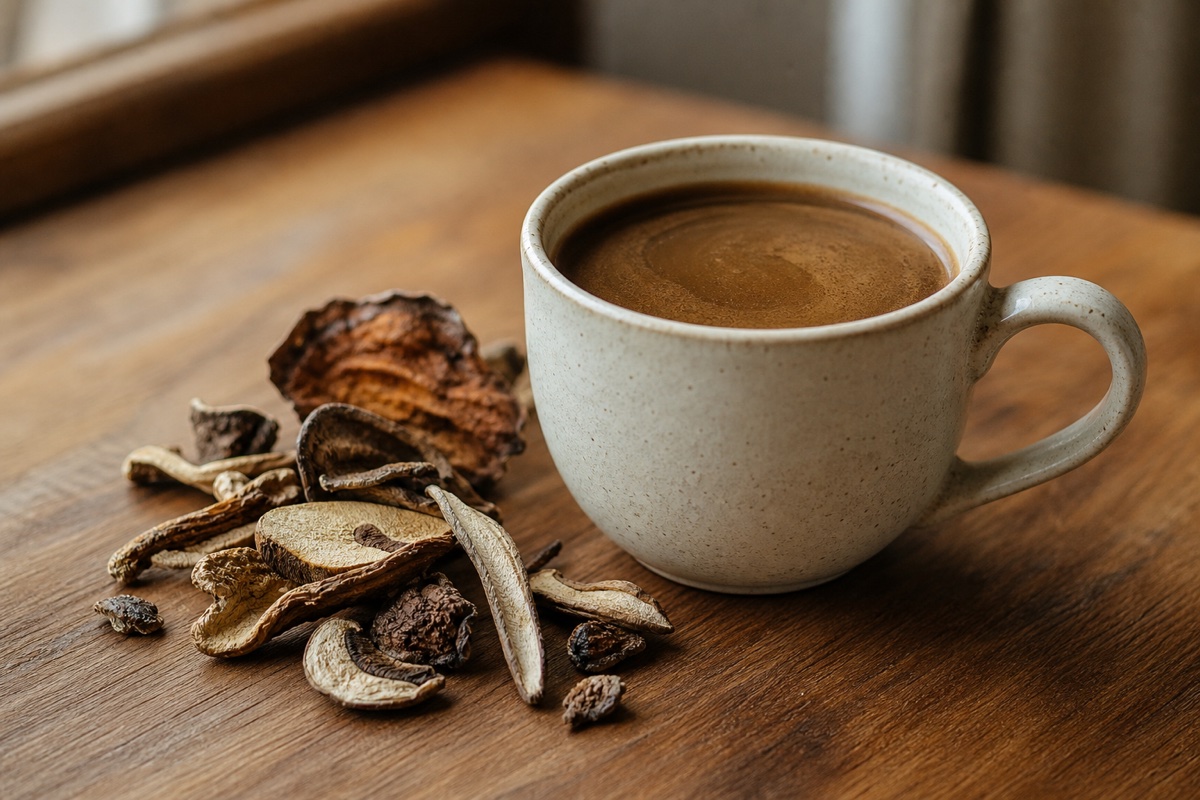
Instant coffee blended with extracts of functional mushrooms — most commonly lion's mane and chaga — marketed as a lower-caffeine, calmer alternative to regular coffee that supposedly adds cognitive and immune benefits on top.
What the evidence shows
Lion's mane has a small number of promising but very early human trials for mood and mild cognitive symptoms; chaga has essentially no human trial data behind the claims made about it. Neither has been tested at the extract doses or preparation actually used in commercial mushroom coffee products.
Mushroom coffee is having a moment on exactly the kind of shelf where “lower caffeine, higher clarity” claims sell well. Here’s what’s actually in the evidence base, and what’s mostly in the marketing.
What it actually is
Mushroom coffee blends instant coffee (usually at a reduced caffeine dose compared to a standard cup) with powdered extracts of functional mushrooms — lion’s mane and chaga are the two most common. The pitch is a smoother, less jittery version of a coffee habit, with cognitive benefits from lion’s mane and immune-support benefits from chaga layered on top.
What the evidence shows
Lion’s mane is the more research-active of the two mushrooms. A 2023 pilot trial in Nutrients [2] gave young, healthy adults a standardised lion’s mane extract for 28 days and found modest improvements in self-reported stress and mood measures compared to placebo. An older, smaller 2009 trial [1] found cognitive benefits in adults with existing mild cognitive impairment — a different population entirely from the “young professional wants sharper focus” audience mushroom coffee is marketed to.
Chaga, by contrast, has essentially no controlled human trial data behind the immune and antioxidant claims routinely made about it — most of what exists is in-vitro or animal-model research, which is a much earlier and less certain evidence tier.
There’s also a practical gap worth naming: none of the human trials used the actual preparation or dose found in a commercial mushroom coffee sachet. They used standardised, measured extracts — a mushroom coffee blend’s exact mushroom content is often proprietary and not disclosed at a comparable dose.
Worth trying?
If you like the taste and want a lower-caffeine coffee alternative, there’s no strong reason not to try it — the lion’s mane research, while early, is at least directionally promising for mood, and the downside risk is low for most healthy adults. Just hold the “cognitive enhancement” and “immune-boosting” marketing claims to what they actually are: early, small, specific-population signals — not settled science, and not proven at the dose in your cup.
Common questions
Does mushroom coffee actually reduce stress?
One small pilot trial found a lion's mane supplement modestly improved self-reported stress and mood measures over 28 days, but it used a standardised extract dose, not the amount typically found in a mushroom coffee blend, and it needs replication before being treated as settled.
Is chaga backed by any human research?
Essentially not, in terms of controlled human trials for the cognitive or immune claims commonly made about it. Most chaga research is in vitro or animal-model work.
Sources cited
- [1]Mori K, Inatomi S, Ouchi K, Azumi Y, Tuchida T (2009). Improving effects of the mushroom Yamabushitake (Hericium erinaceus) on mild cognitive impairment: a double-blind placebo-controlled clinical trial . Phytotherapy Research.Small trial (n=30), older adults with mild cognitive impairment specifically — not a healthy general-population sample.Single RCT
- [2]Docherty S, Doughty FL, Smith EF (2023). The Acute and Chronic Effects of Lion's Mane Mushroom Supplementation on Cognitive Function, Stress and Mood in Young Adults: A Double-Blind, Parallel Groups, Pilot Study . Nutrients.Single RCT
Related on thesmartplate.org

Do Nootropics Actually Work?
Some compounds marketed as nootropics have real trial support. Most of the 'stack' culture around them doesn't. Here's the difference.

Best Foods and Drinks for Focus
Most 'brain food' content is aesthetic. This is the actual evidence on caffeine, glucose, and attention.

What a Creatine and Cognition Review Actually Found
A systematic review of RCTs found creatine supplementation gave modest cognitive benefits, most consistently under cognitive stress like sleep deprivation, or in people with lower baseline creatine stores, such as vegetarians.